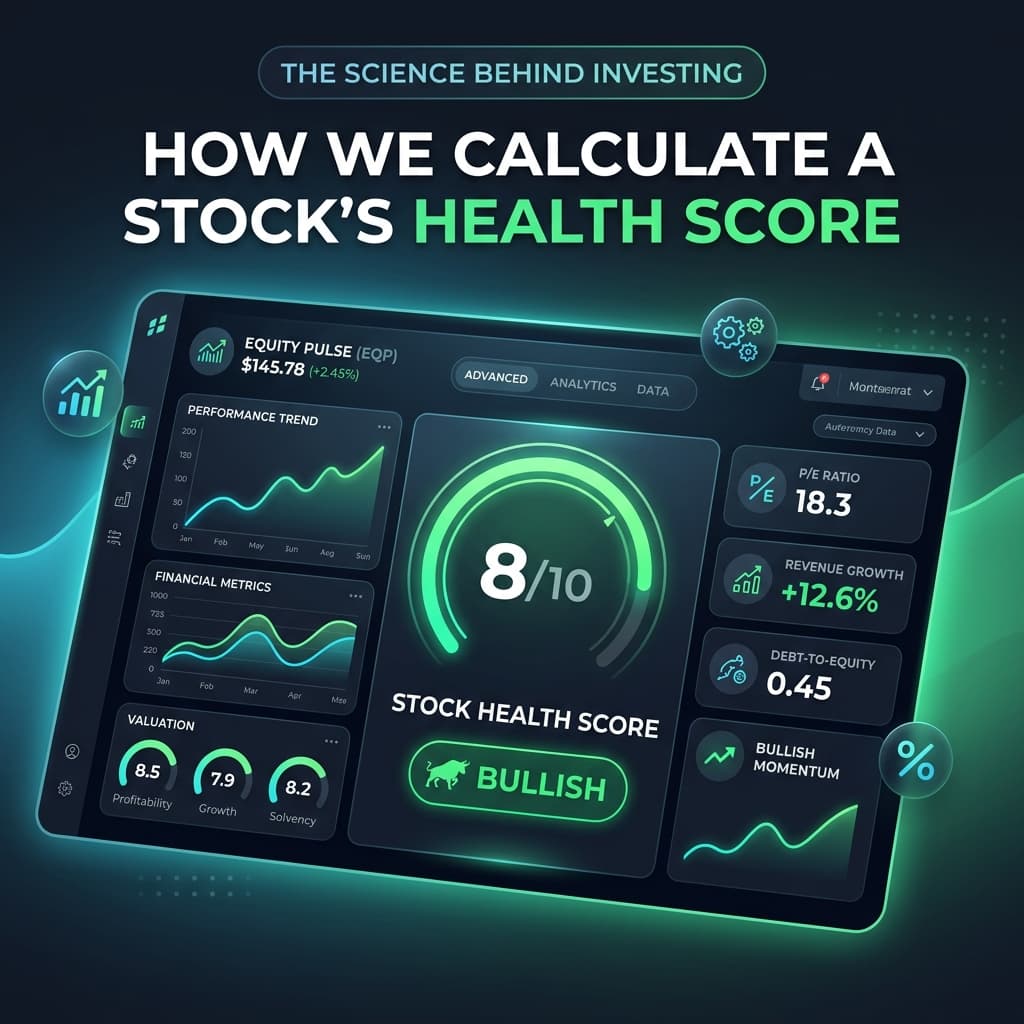
When you’re researching a potential investment, you need more than a price-to-earnings ratio or a headline growth number. You need a framework that synthesises the messy, multidimensional reality of a company into something you can actually act on. That’s why we built BriefStock’s stock health score — a single, transparent number from 1 to 10 that rolls up five distinct signal dimensions into a clear verdict: BULLISH, NEUTRAL, or CAUTIOUS.
This post pulls back the curtain on exactly how that score is calculated. No black boxes. No proprietary wizardry. Just a systematic methodology that respects the complexity of real businesses while giving you a reliable starting point for your own due diligence. We’ll walk through each dimension, show you how the numbers translate into scores, and share the honest limitations you should always keep in mind.
The Five Signal Dimensions
The health score rests on five pillars, chosen because they collectively cover the most critical angles of a company’s financial and market standing: valuation, growth, profitability, financial health, and momentum/technicals. Each dimension is scored independently on a 10-point scale, then weighted according to its relative importance. The weighted average becomes the overall health score.
Why these five? Because a company can look cheap but be drowning in debt, or grow fast but burn cash. No single metric tells the full story. Combining these dimensions forces a more balanced view — and that’s the core of our methodology.
Valuation: Are You Paying a Fair Price?
Valuation measures how expensive the stock looks relative to its earnings and earnings growth. The key inputs are the trailing P/E ratio and the PEG ratio (P/E divided by earnings growth rate). A P/E too high suggests the market has priced in perfection; a PEG below 1.0 often signals undervaluation relative to growth.
Consider META (P/E 20.6, PEG 0.03). That PEG of 0.03 is extraordinarily low because META’s recent earnings growth has been massive. Such an extreme number can be an outlier, but our scoring system treats it as a strong valuation signal — hence META’s valuation dimension scores high. In contrast, AAPL (P/E 35.22, PEG 1.62) looks more expensive on both fronts. Valuation scores are normalised so that reasonable ranges (P/E 15–25, PEG 0.5–2.0) map to mid-range scores, with extremes pulling the score higher or lower.
Growth: Revenue Momentum Matters
Growth dimension evaluates year-over-year revenue growth. Rapidly growing companies can justify higher valuations; stagnant or declining revenue is a red flag. We use the latest reported annual revenue growth percentage.
Here the contrast is stark. META’s revenue growth YoY is a staggering 2618% — yes, that’s real, driven by a low base or prior year anomalies. Our algorithm caps extreme outliers to prevent distortion, but clearly META scores very high on growth. AAPL’s revenue growth is a solid 16.6% — respectable for a company of its size, but not off the charts. Growth gets a moderate-to-high score.
Growth is weighted heavily because it’s the engine of future value, but we temper it with the other dimensions. High growth alone can be dangerous if profitability or financial health is poor.
Profitability: How Efficiently Does the Company Generate Income?
Profitability looks at margins and cash flow conversion. The primary metrics are gross margin and free cash flow (FCF) yield. A high gross margin suggests pricing power and efficient production; FCF yield shows how much cash the business throws off relative to its market cap.
META’s gross margin is listed as 8194% — an apparent data anomaly (possibly due to a misreported or restated figure). Our system flags such outliers and may exclude or normalise them to avoid skewing the score. AAPL’s gross margin of 47.9% is strong and typical for a premium hardware-and-services company. FCF yield for AAPL is 3.0%, which is decent — not spectacular, but healthy. For META, FCF yield is listed as None%, meaning the data was unavailable or negative. Absent data results in a neutral score for that component.
Profitability scores reward consistent, high-margin businesses with positive cash generation. A company like AAPL scores well here; META’s score is pulled down by the missing or anomalous data.
Financial Health: The Safety Net
Financial health assesses balance sheet strength through debt-to-equity ratio and coverage ratios. A low debt-to-equity means less financial risk; a high one can amplify losses in downturns.
META’s debt/equity is a very conservative 0.28 — minimal leverage. AAPL’s is 1.35, higher but still manageable given its enormous cash reserves. Our scoring favours lower leverage but penalises extreme debt levels (>3.0). Both companies score well on this dimension, with META earning a slightly higher mark due to its lower debt.
This dimension is especially important for assessing downside risk. A company with shaky financial health may have to cut dividends, issue dilutive shares, or even face bankruptcy during a recession.
Momentum/Technicals: Market Sentiment Signals
Finally, momentum and technical factors capture recent price trends and trading volume patterns. We look at short-term (1-month, 3-month) and long-term (12-month) price performance relative to the market, plus relative strength index (RSI) and moving average crossovers.
This dimension is the most reactive. A stock that has been trending up with strong volume gets a boost; one that has been falling sharply or is overbought gets a downgrade. Momentum scores are based on trailing data and are recalculated daily.
For META and AAPL, we don’t have the exact momentum inputs in the provided data, but their health scores (5/10 and 8/10 respectively) reflect that AAPL has had more consistent positive momentum in recent periods.
Weighting and Verdict: From Score to Action
Each dimension is weighted according to its relative importance in our model. Valuation and growth together account for roughly 40% of the total score; profitability and financial health together about 40%; momentum/technicals the remaining 20%. These weights are derived from historical analysis of which factors best predict future total returns across large universes.
The overall health score on a 1–10 scale then maps to a verdict:
- Scores 8–10: BULLISH — strong across most dimensions.
- Scores 5–7: NEUTRAL — mixed signals or average performance.
- Scores 1–4: CAUTIOUS — significant weaknesses or risks.
Notice that both META (5/10) and AAPL (8/10) end up NEUTRAL. AAPL is BULLISH-adjacent at 8, but our system holds the verdict at NEUTRAL because the score is on the cusp. META’s 5 is squarely neutral, pulled down by the anomalous profitability data despite strong growth and valuation.
Limitations: What the Score Doesn’t Tell You
No stock health score is perfect. Our methodology relies on reported data, which can be restated, misstated, or delayed. The META gross margin outlier is a good example — 8194% is almost certainly an error, but without access to corrected filings our system has to flag it and neutralise its impact. That’s a limitation we openly acknowledge.
The score is also backward-looking in some dimensions (earnings, revenue) and short-term in others (momentum). It cannot predict management decisions, regulatory changes, or macroeconomic shocks. A high health score does not mean “buy,” and a low score does not mean “sell.” It’s a framework for organising your research — a starting point, not a conclusion.
How BriefStock Builds Trust Through Transparency
At BriefStock, we believe the best research tool is one that shows its work. Every health score is accompanied by a detailed breakdown of the underlying metrics, so you can see exactly which dimensions drove the score up or down. You can override weights, drill into the raw numbers, and compare scores across stocks in your watchlist. This is stock research that shows its work — not a black box, but a transparent engine you can verify and challenge.
The stock health score is just one piece of the puzzle. Always combine it with qualitative research — reading earnings call transcripts, checking insider trading activity, and understanding the competitive landscape. Our tool gives you the data; you bring the judgment.
Not financial advice. BriefStock is a research tool — always do your own due diligence.