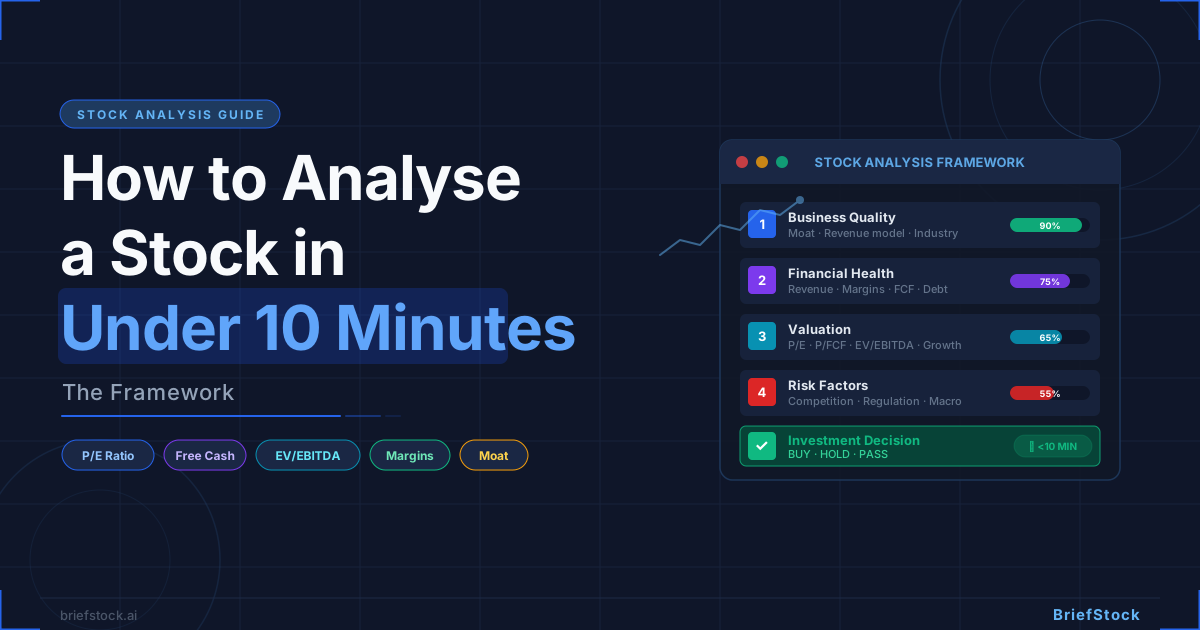
If you've ever stared at a stock screen wondering where to even begin, you're not alone. Knowing how to analyse a stock properly — without drowning in spreadsheets or financial jargon — is one of the most valuable skills a self-directed investor can build. The good news: a structured framework gets you 80% of the way there in a fraction of the time most people spend. Here's a seven-step process you can run through in under ten minutes.
Step 1: Understand the Business Model First
Before you look at a single number, ask one question: how does this company make money?
This sounds obvious, but investors skip it constantly. A business with a simple, durable revenue model is far easier to evaluate — and far easier to own through volatility — than one with a complex web of revenue streams you don't fully understand.
Ask yourself: Does the company sell a product, a subscription, or advertising? Is the customer a business or a consumer? Is there a recurring revenue element? Can the company raise prices without losing customers?
You don't need a deep strategic thesis at this stage. You just need enough clarity to know what you're evaluating when the numbers appear.
Step 2: Check the Revenue Trajectory
Growth is the engine of equity returns. A company that isn't growing is either a value trap or a dividend story — and you need to know which one you're dealing with before you go further.
Look at year-over-year revenue growth and ask whether it's accelerating, steady, or declining. Context matters enormously here. An 18% growth rate means something very different for a $2 trillion company than for a $200 million one.
Take Amazon (AMZN) as a live example: revenue growth of 18.4% year-over-year at its scale is genuinely impressive. That's not startup-mode growth, but it signals a business still expanding meaningfully across its core segments.
Compare that to a company growing at 3% in a sector growing at 12%, and you have a very different picture — one that warrants serious questions before you go any further.
Step 3: Assess Profitability — Gross Margin Is Your Starting Point
Revenue growth without profitability is a story, not a business. The first number to check is gross margin, which tells you how much of each revenue dollar the company keeps after its direct costs.
High gross margins indicate pricing power, scalability, and competitive moat. Low gross margins aren't automatically disqualifying — grocery retailers operate on thin margins by design — but they do mean the business needs high volume and tight cost control to generate real earnings.
META's gross margin of 81.8% is a striking example. For every dollar of revenue, the company retains 82 cents before operating expenses. That's the profile of a software or platform business with near-zero marginal cost of delivery. AMZN's 48.5% gross margin reflects its more capital-intensive model — still healthy, but structurally different.
From gross margin, move to operating margin and net income to understand what actually reaches the bottom line.
Step 4: Run a Valuation Check Against the Sector
This is where most retail investors either over-simplify (P/E ratio alone) or over-complicate (DCF models with 47 assumptions). The goal at this stage is a quick sanity check — is this stock priced for perfection, or is there room for error?
The P/E ratio gives you a starting point. AMZN trades at 30.35x earnings, META at 25.54x. Neither is cheap in absolute terms, but valuation only makes sense relative to growth. That's where the PEG ratio becomes useful — it divides the P/E by the earnings growth rate to produce a growth-adjusted valuation.
META's PEG of 0.03 is unusually low, suggesting the market is pricing in far less growth than current earnings trajectory implies. AMZN's PEG of 1.61 is more conventional — roughly fair value when growth is factored in.
BriefStock surfaces both figures automatically alongside sector benchmarks, so you're not doing this comparison in a vacuum.
Step 5: How to Analyse a Stock's Balance Sheet Without the Complexity
Debt doesn't kill businesses overnight — but it amplifies every other problem. A company with a strong balance sheet can weather downturns, invest counter-cyclically, and avoid the dilution that crushes shareholder value in a crisis.
The quickest signal is the debt-to-equity ratio. As a rule of thumb, anything below 1.0 is manageable for most businesses; anything above 2.0 warrants a closer look at the interest coverage ratio and maturity schedule.
Both AMZN and META sit at impressively low levels here — 0.37 and 0.39 respectively. That means for every dollar of equity, each company carries less than 40 cents of debt. At their scale, this represents significant financial flexibility. It's one reason both carry BULLISH verdicts in our current analysis.
Free cash flow yield is the companion metric. It tells you how much cash the business generates relative to its market cap. Low FCF yield can mean the stock is expensive, or that the business is in heavy investment mode — you need the business model context from Step 1 to interpret it correctly.
Step 6: Read the Insider and Analyst Signals
No single signal here should be treated as a decision-maker. But insider activity and analyst sentiment are useful data points that tell you how people with far more information than you are positioning themselves.
Insider buying — particularly by executives purchasing open-market shares with their own money — has historically been a meaningful positive signal. It's not foolproof, but it's one of the few truly skin-in-the-game signals available to retail investors.
Analyst consensus matters less for its directional call (most stocks get "Buy" ratings regardless) and more for its dispersion. A stock with 20 analysts split evenly between BULLISH and CAUTIOUS is telling you something about genuine uncertainty. A stock with unanimous conviction in either direction is worth understanding before you act.
Look for recent changes in price targets too. A cluster of upward revisions following an earnings report often reflects a structural reassessment of the business, not just short-term optimism.
Step 7: Check the Technical Position Before You Buy
Fundamentals tell you what to buy. Technicals help you decide when. This doesn't require becoming a chart technician — a few simple checks are enough to avoid buying into obvious short-term resistance or catching a falling stock mid-breakdown.
Look at where the stock sits relative to its 50-day and 200-day moving averages. A stock trading above both, with the 50-day crossing above the 200-day (a "golden cross"), is in a confirmed uptrend. The reverse — below both averages, with a declining slope — is a technical headwind worth acknowledging even if the fundamentals are strong.
Check recent volume on up days versus down days. Sustained buying volume on rallies and light volume on pullbacks is the profile of a healthy technical structure. The inverse suggests distribution — institutional selling into retail buying pressure.
You don't need to let technicals override a strong fundamental case. But ignoring price action entirely means you're leaving useful information on the table.
Putting It All Together
A strong stock analysis pulls all seven of these steps into a coherent picture. A company can score well on six criteria and still be a poor investment if the valuation is extreme or the balance sheet is deteriorating. The framework isn't a checklist — it's a diagnostic tool that helps you identify where the real risk and opportunity actually live.
META, for example, scores 9/10 on BriefStock's Health Score — strong gross margins, low debt, and a growth-adjusted valuation that looks attractive relative to peers. AMZN comes in at 7/10, reflecting strong growth and balance sheet health offset by a thinner FCF yield and the capital intensity of its infrastructure model.
Neither is a simple story. That's the point.
Knowing how to analyse a stock well means building a complete picture quickly — not optimising any single metric in isolation. The investors who do this consistently and systematically are the ones who make better decisions over time, not because they have better data, but because they use what they have more deliberately.
BriefStock is built to run this entire framework automatically — surfacing the metrics, context, and verdict for any stock in seconds. Because the best analysis is the kind you actually do. Stock research that shows its work.
Not financial advice. BriefStock is a research tool — always do your own due diligence.