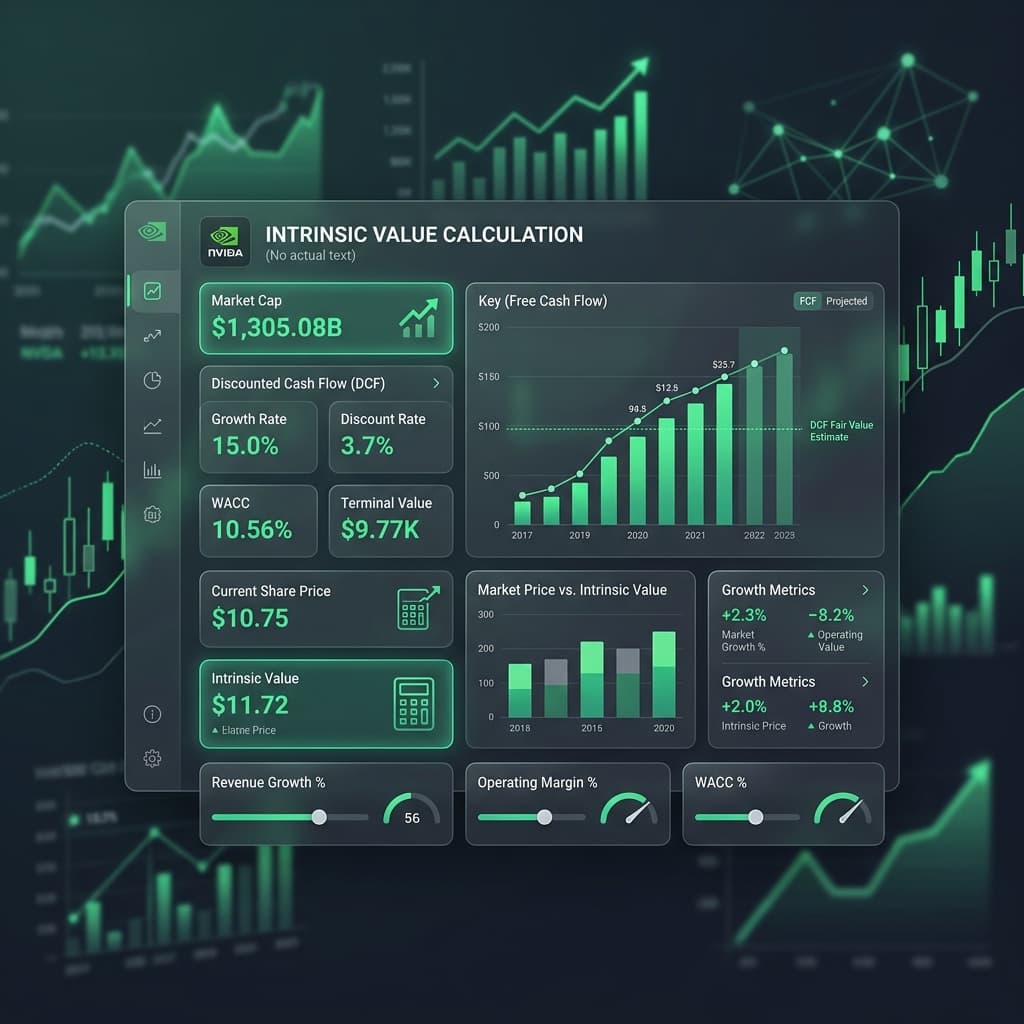
If you've ever spent time in a professional investment bank or a high-end hedge fund, you've heard the term "DCF." Short for Discounted Cash Flow, it's considered by many to be the "gold standard" of business valuation.
While metrics like the P/E ratio or FCF Yield tell you how a stock is priced relative to others, a DCF attempts to calculate the intrinsic value of a company based solely on its future cash potential. In simple terms: a business is worth the sum of all the cash it will ever generate in the future, discounted back to what that cash is worth today.
But behind the complex spreadsheets and academic formulas, a DCF is actually quite intuitive. It’s the ultimate "bottom-up" way to understand what you are actually buying when you click "buy" on a stock ticker.
The Core Principle: Time Value of Money
The foundation of a DCF is the time value of money. A dollar today is worth more than a dollar ten years from now because you can invest that dollar today and earn an interest-bearing return. Conversely, a dollar receiving 10 years from now is worth less than a dollar today.
In a DCF, we project a company's future cash flows and "shrink" them back to their present value using a discount rate. This rate (often the Weighted Average Cost of Capital, or WACC) represents the return an investor would expect elsewhere for a similar level of risk. If a company can't beat that rate, it is effectively destroying value for its owners.
The Two Key Inputs
Every DCF model relies on two primary assumptions:
- Projected Free Cash Flows (FCF): What the company will earn over the next 5 to 10 years (the "projection period").
- Terminal Value: What the company is worth at the end of that period, assuming it continues to grow at a slow, steady rate forever.
A Simplified 5-Year DCF Walkthrough
Let's look at a hypothetical company, "FutureGrowth Inc.," with the following assumptions:
- Current FCF (Year 0): $100 million
- Expected Growth Rate: 15% for the next 5 years
- Discount Rate (WACC): 10%
- Terminal Growth Rate: 3% (about the rate of GDP growth)
Step 1: Projecting Future FCF
First, we grow the current $100M FCF by our 15% rate for each year of the projection period:
- Year 1: $115.0M
- Year 2: $132.3M
- Year 3: $152.1M
- Year 4: $174.9M
- Year 5: $201.1M
Step 2: Discounting Back to Today
Next, we apply the 10% discount rate to each of those years. The formula for the present value (PV) of any future year n is:
PV = Cash Flow / (1 + Discount Rate)^n
- Year 1 PV: $115 / 1.10^1 = $104.5M
- Year 2 PV: $132.3 / 1.10^2 = $109.3M
- Year 3 PV: $152.1 / 1.10^3 = $114.3M
- Year 4 PV: $174.9 / 1.10^4 = $119.5M
- Year 5 PV: $201.1 / 1.10^5 = $124.9M
Total Present Value of the 5-Year High-Growth Period: ~$572.5 Million
Step 3: The Terminal Value (The Value Engine)
Most of a company's value actually comes after "Year 5." Since we can't project specifically for Year 50, we use a shortcut called the Gordon Growth Model. This assumes the company will grow at a steady 3% forever.
Terminal Value = (Year 5 Cash Flow * (1 + Terminal Growth Rate)) / (Discount Rate - Terminal Growth Rate)
Terminal Value = ($201.1M * 1.03) / (0.10 - 0.03) = $207.1M / 0.07 = $2.96 Billion
Now, we must discount that $2.96 billion back to Year 0 (today), since it’s a future value receipt at the end of Year 5:
- PV of Terminal Value: $2.96B / 1.10^5 = $1.84 Billion
Step 4: The Final Intrinsic Valuation
The total intrinsic value of FutureGrowth Inc. is the sum of the first 5 years plus the discounted terminal value:
Total Enterprise Value = $572.5M + $1.84B = $2.41 Billion
To find the "per share" value, we would subtract the company's debt, add its cash, and divide by the total number of shares outstanding. If the current market price is significantly lower than this final number, the stock is potentially undervalued.
The Sensitivity Analysis: Why Analysts Disagree
The beauty of a DCF is that it "shows its work." But it also reveals a terrifying reality: small changes in your starting assumptions lead to massive changes in the final valuation.
Consider this: In our example, we used a 10% discount rate. If we change that to 12% because we think the market is riskier:
- The terminal value drops from $2.96B to $2.31B.
- The total valuation falls by nearly 25%.
This is why traditional research tools often give wildly different price targets for the same company. One analyst might be slightly more optimistic about the growth rate (15% vs 12%), and another might use a slightly different discount rate. This leads to the "garbage in, garbage out" problem—a DCF is only as good as the human judgment that builds its inputs.
Limitations of the DCF
- Extreme Sensitivity: A 1% change in the terminal growth rate can swing a valuation by billions.
- Reliance on the Future: Predicting cash flows for a decade is inherently speculative. One disruption in technology (like AI replacing a legacy service) can make a 10-year projection irrelevant.
- The "Black Box" Problem: Most platforms hide these calculations behind a "Fair Value" target. You see the result, but you never see the building blocks.
When DCF is Best Used
A DCF is most effective for mature, stable companies with predictable cash flows (like Apple, Microsoft, or Coca-Cola). It is far less effective for high-growth startups or biotech firms where the first few years are guaranteed to be negative and the terminal value is a total guess. In those cases, relative valuation (like the PEG ratio) is often more practical.
Summary: Building a Margin of Safety
The goal of a DCF isn't to find the "perfect" price of a stock. The goal is to build a Margin of Safety. By running a DCF with conservative assumptions, you find the price at which you are comfortable buying even if things don't go perfectly. If your conservative DCF says a stock is worth $100 and it’s trading at $70, you have found a potential opportunity.
At BriefStock, we believe in radical transparency. We don’t just report a "Fair Value" and expect you to take our word for it. We run our internal DCF calculations using live, reported financials and reveal every assumption we make. We show you the growth rates, the discount rates, and the terminal values we used to build our model.
We don't just tell you what a stock is worth; we provide the data and the "shows its work" transparency so you can decide if those assumptions match your own thesis. Valuation is a blend of science and art, and we give you the tools to master both.