If you've spent any time reading equity research or analyst reports, you've almost certainly seen EV/EBITDA cited as a core valuation metric. But what is EV/EBITDA, exactly — and why do professional investors often reach for it before they even glance at the price-to-earnings ratio? This post breaks it down from the ground up: the components, the logic, the sector benchmarks, and the real limitations you need to understand before putting it to work.
Breaking Down the Two Components
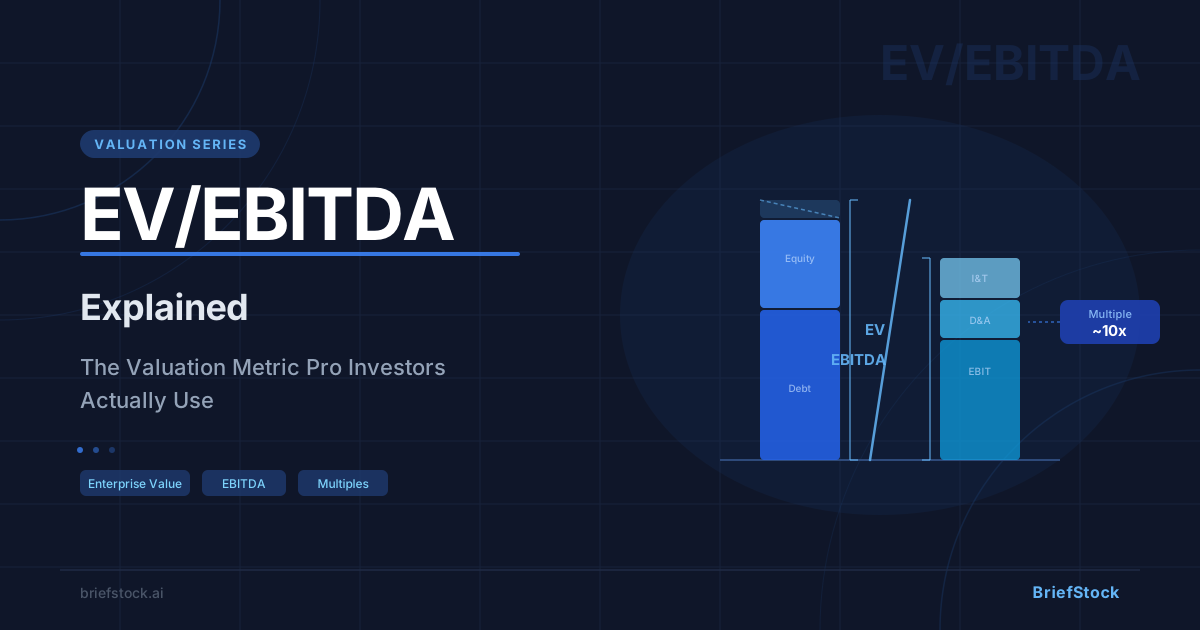
EV/EBITDA is a ratio that divides a company's enterprise value by its earnings before interest, taxes, depreciation, and amortization. To understand the ratio, you have to understand each piece independently.
Enterprise value (EV) is often described as the theoretical takeover price of a business. It starts with market capitalization — the share price multiplied by shares outstanding — and then adds total debt while subtracting cash and cash equivalents. The logic is straightforward: if you bought a company outright, you'd inherit its debt obligations but also capture its cash on hand. EV accounts for both.
EBITDA is a proxy for operating cash generation. Strip out interest (which reflects financing decisions, not operations), taxes (which vary by jurisdiction and structure), and non-cash charges like depreciation and amortization, and you're left with something closer to how much cash the underlying business actually produces from its core activities.
Put the two together and you get a ratio that measures how many times over the market is pricing the company's operating earnings power — independent of how it's financed.
What Is EV/EBITDA Actually Measuring?
Here's why the metric matters in practice. Price-to-earnings compares share price to net income, which is the bottom line after interest and taxes have already been deducted. That means two companies with identical operating businesses but different capital structures — one loaded with debt, one debt-free — will show very different P/E ratios even though their underlying economics are similar.
EV/EBITDA sidesteps that problem. Because enterprise value includes debt and EBITDA sits above the interest line, you can compare a highly leveraged utility to a cash-rich tech company on something closer to an apples-to-apples basis.
This also makes EV/EBITDA particularly useful in sectors where capital structure is a fundamental feature of the business model — think telecommunications, infrastructure, energy, and real estate. In these industries, using P/E alone can give you a badly distorted picture of relative value.
Where P/E Falls Short — and EV/EBITDA Fills the Gap
Consider two real-world snapshots. AMD carries a P/E of 82.46 — a number that, in isolation, looks expensive by almost any historical standard. JPMorgan, by contrast, trades at a P/E of 14.74, which superficially appears cheap.
But raw P/E comparisons across different sectors and capital structures are almost meaningless. AMD carries a debt-to-equity ratio of just 0.07 — effectively unleveraged — while JPMorgan's debt-to-equity sits at 2.6, reflecting the balance-sheet-intensive nature of banking. AMD's P/E is high partly because it's a growth business with a 54.3% gross margin and 11.1% year-over-year revenue growth, while JPMorgan's revenue declined 3.2% over the same period. EV/EBITDA, by stripping out the capital structure noise, lets you examine whether a company's operating earnings are cheap or expensive relative to what the market is paying for the whole enterprise.
BriefStock surfaces these structural differences automatically — including debt-to-equity, gross margin, and revenue growth — so you're not comparing P/E ratios across businesses that aren't actually comparable.
Typical EV/EBITDA Ranges by Sector
There's no universal "cheap" or "expensive" threshold for EV/EBITDA. Acceptable ranges vary significantly by sector, primarily because growth rates and capital intensity differ so widely.
Technology companies — particularly high-growth software and semiconductor businesses — often trade at EV/EBITDA multiples of 20x to 40x or higher when markets are pricing in strong future earnings growth. Consumer staples and utilities, which grow slowly but predictably, typically trade in the 8x to 14x range. Industrials and energy companies often sit somewhere in between, commonly in the 6x to 12x range depending on the commodity cycle.
Mergers and acquisitions activity provides another useful reference point. In private market transactions, businesses across a broad range of industries have historically changed hands in the 6x to 10x EBITDA range, which is why many value-oriented public market investors use that band as a rough baseline for "fair value" in mature sectors.
The key takeaway: always compare EV/EBITDA within a sector, or at minimum, adjust your expectations significantly when crossing sector lines.
The Real Limitations You Can't Ignore
EV/EBITDA is a useful tool, but it has genuine blind spots that can mislead you if you treat it as a complete picture.
The biggest issue is capital expenditure. EBITDA adds back depreciation, which is supposed to represent the economic wear on a company's physical assets. But if a business needs to spend heavily just to maintain its existing asset base — think railroads, telecoms, or manufacturers with aging equipment — then EBITDA overstates the actual cash available to equity holders. In capital-intensive businesses, free cash flow yield is often a more honest measure of earnings power.
JPMorgan's free cash flow yield of 12.7% versus AMD's 1.9% illustrates this gap clearly. Despite AMD's strong operating momentum, the FCF yield suggests the market has priced in a lot of future growth — and that the current cash generation doesn't fully support today's valuation without continued execution. For JPMorgan, that 12.7% FCF yield raises a different kind of question: if cash generation is that strong, why is BriefStock's verdict CAUTIOUS? The answer lies in revenue contraction of 3.2% and the structural complexity of bank accounting, where EBITDA itself is a less reliable metric than it would be in other sectors.
That leads to a second limitation: EBITDA is genuinely difficult to interpret for financial companies. Banks and insurers don't carry debt the same way an industrial company does — liabilities are part of the product. EV/EBITDA is essentially not applicable as a primary metric for financials. Price-to-book and price-to-earnings relative to return on equity tend to do more work in those sectors.
How EV/EBITDA Fits Into a Full Valuation Picture
No single ratio tells you whether a stock is worth buying. The most useful role EV/EBITDA plays is as a screening and cross-check tool — a way to quickly flag whether a company looks expensive or cheap relative to its sector peers before you go deeper.
In practice, sophisticated analysts layer EV/EBITDA alongside free cash flow yield (to check whether the earnings being valued are actually turning into cash), the PEG ratio (to adjust for growth), and gross margin trends (to assess whether the business model is durable). AMD's PEG of 3.82 suggests the market is paying a meaningful premium for its growth profile — that's context EV/EBITDA alone wouldn't give you.
The goal isn't to find the one magic ratio. It's to build a consistent framework where multiple metrics either corroborate each other or flag a tension worth investigating. When EV/EBITDA looks cheap but FCF yield is terrible, that tension deserves an explanation. When EV/EBITDA looks rich but gross margins are expanding and the PEG is reasonable, the premium may be justified.
Putting It All Together
Understanding what is EV/EBITDA is really about understanding what it's designed to solve: the problem of comparing businesses with different financing structures on a level playing field. It's more capital-structure-neutral than P/E, more widely applicable than price-to-book, and more intuitive than many of the more complex valuation models analysts use.
That said, it works best as part of a layered analysis — checked against FCF yield, tempered by sector context, and stress-tested against the specific capital intensity of the business you're evaluating. Treat it as one strong lens among several, and it'll serve you well. Treat it as the only answer, and it'll eventually mislead you.
Not financial advice. BriefStock is a research tool — always do your own due diligence.