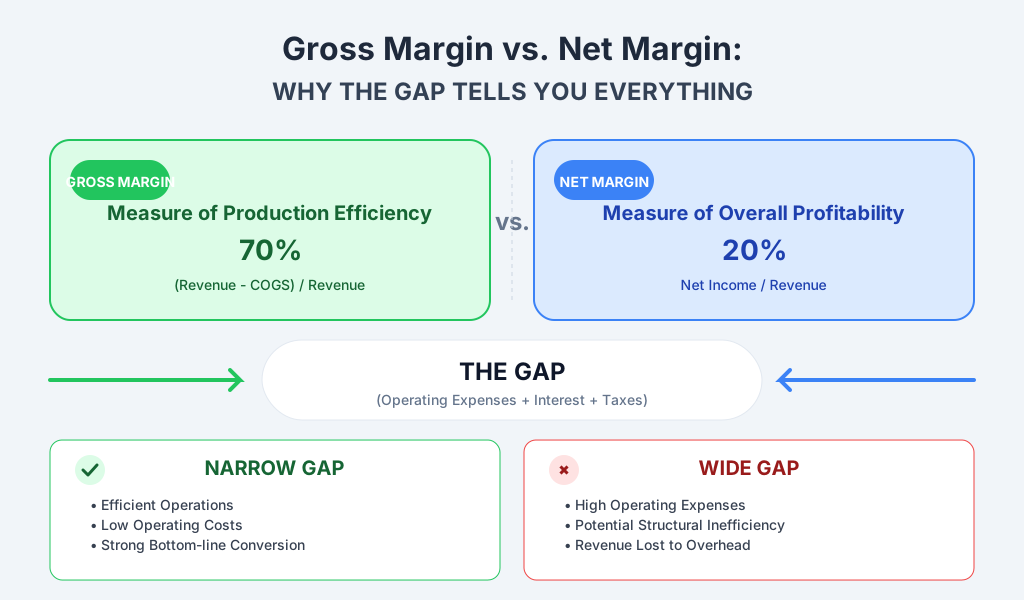
When investors talk about profitability, they often treat margin figures as interchangeable. They're not. Understanding gross margin vs net margin — and specifically the spread between them — is one of the most underrated skills in fundamental analysis. A company can post an impressive gross margin and still bleed cash at the bottom line. The gap between those two numbers tells you exactly where the money is going, and whether management is spending it wisely or just burning it.
What Gross Margin Actually Measures
Gross margin is simple in concept: revenue minus the cost of goods sold (COGS), divided by revenue. It measures how efficiently a company produces whatever it sells before any other costs enter the picture.
For a software company, COGS might include server infrastructure and customer support. For a manufacturer, it's raw materials, labor, and production overhead. The higher the gross margin, the more room a business has to absorb operating expenses and still generate profit.
Microsoft's gross margin of 68.0% is a useful benchmark here. That figure reflects a business built largely on high-margin software licensing and cloud services — products that scale without proportional cost increases. When you're keeping 68 cents of every revenue dollar before operating expenses, you start with a significant structural advantage.
AMD, by contrast, carries a gross margin of 54.3%. That's still strong by most standards, but it reflects a more hardware-intensive model where chip design, manufacturing partnerships, and component costs create a higher baseline cost structure. Neither number is "bad" in isolation — the context of the business model is everything.
What Net Margin Adds to the Picture
Net margin takes the full journey into account. It's what's left after COGS, operating expenses (R&D, sales and marketing, G&A), interest, taxes, and any one-time items. If gross margin tells you how well a company controls its production economics, net margin tells you how well it controls everything else.
The spread between gross margin and net margin is where the real story lives. A company with a 70% gross margin and a 5% net margin is spending an enormous amount on something between those two lines. That could be intentional — heavy R&D investment, aggressive sales expansion, or a land-grab phase that will eventually normalize. Or it could signal structural inefficiency that never improves.
Neither interpretation is automatically correct. But you need to know which one you're looking at before you build a position.
The Spread Reveals Operating Leverage and Cost Structure
Operating leverage describes how much of each incremental revenue dollar falls to the bottom line once fixed costs are covered. A business with high operating leverage sees profit expand rapidly as revenue scales — because its fixed cost base doesn't grow proportionally.
The gross-to-net spread gives you a proxy for this. A company with a 65% gross margin and a 30% net margin has relatively tight operating costs — it's converting about half of its gross profit into net income. That's a different business than one with the same gross margin but a 10% net margin, where operating expenses are absorbing most of the cushion.
R&D intensity is a major driver of this gap in technology sectors. Semiconductor and software companies often reinvest 15–25% of revenue into R&D, which compresses net margins even when gross margins look healthy. This isn't inherently negative — it's the cost of maintaining competitive position in fast-moving markets. But it does mean you're betting that the R&D eventually translates into revenue growth or margin expansion.
BriefStock surfaces both margin figures alongside revenue growth and health scores precisely because no single number tells a complete story.
Sector Benchmarks Worth Knowing
Margin profiles vary dramatically by sector, and comparing a retailer to a software company on gross margin alone is a category error.
Software and cloud businesses typically carry gross margins in the 60–80% range. Physical retail often runs 25–40%. Industrial manufacturers might land between 30–50%. Healthcare and pharma vary widely depending on the mix of branded drugs, generics, and services. Financial services operate differently still, where interest margins and fee structures make traditional gross margin calculations less meaningful.
Within these ranges, what matters most is the trajectory. A retail company expanding from 32% to 36% gross margin over three years while holding net margin steady is demonstrating real pricing power or cost discipline. A software company seeing gross margin hold at 68% while net margin erodes from 28% to 19% is spending faster than it's growing — and deserves closer scrutiny.
The absolute level of gross margin tells you about business model quality. The trend in the gross-to-net spread tells you about operational trajectory.
A Shrinking Spread Is Often an Early Warning Sign
This is the pattern that trips up investors most often. A company maintains its gross margin while the net margin quietly deteriorates over several quarters. Revenue growth looks fine. The stock narrative holds. But something is wrong in the middle of the income statement.
What drives this? It can be rising R&D spend ahead of a product cycle — which may be justified. It can be expanding headcount in sales without corresponding revenue conversion. It can be rising interest expense from debt taken on during a low-rate environment, now repricing. Or it can be the slow accumulation of inefficiencies that management isn't addressing.
In all cases, a shrinking gross-to-net spread deserves a specific answer from management, not a generic "we're investing for growth" response. If the explanation is credible and time-bound — "we're absorbing integration costs from the acquisition and expect normalization by Q3" — that's different from a pattern that's been deteriorating for six consecutive quarters with no inflection in sight.
Watching this metric over time requires consistent data, which is why tracking margins across multiple periods matters more than any single quarter snapshot.
Gross Margin vs Net Margin in Practice: Reading a Real Example
Return to Microsoft. A gross margin of 68.0% in a mature, diversified software and cloud business reflects durable competitive advantage. The BULLISH verdict assigned to MSFT — alongside a health score of 9/10, a debt-to-equity ratio of 0.33, and a PEG of 0.61 — suggests a business where the gross margin quality is reinforced by efficient capital allocation and disciplined cost structure.
Now consider AMD. The 54.3% gross margin reflects a business that requires more cost to deliver its product, but AMD operates in a market with substantial long-term tailwinds in AI and data center chips. At a P/E of 82.46 and a PEG of 3.82, investors are paying a meaningful premium. In that context, margin trends matter even more — you need AMD's gross margin to hold or expand as it scales, and you need to see operating leverage emerge to justify the multiple.
The gross-to-net spread for AMD deserves ongoing attention. If R&D spend is the main gap driver, the question is whether those investments are translating into product cycles that can support margin expansion. If they are, the current spread is a temporary investment. If they aren't, it's a structural drag on a stock that's priced for perfection.
How to Use This in Your Own Analysis
Start by pulling gross margin and net margin for any company you're evaluating, then do simple math: what's the spread, what's inside it, and is it getting larger or smaller?
Cross-reference the operating expense breakdown. Most income statements separate R&D, sales and marketing, and G&A — which lets you identify which cost line is driving the gap. Then look at the trend across at least six to eight quarters rather than relying on a single period.
Ask whether the spread makes sense for the business model and stage. A pre-profitability company investing heavily in R&D will have a wide spread by design. A mature business seeing its spread widen unexpectedly is a different situation entirely.
BriefStock includes margin data in its research summaries for exactly this reason — so you can see not just what the margins are, but whether the relationship between them is telling a coherent story.
The Bottom Line
Gross margin vs net margin isn't just a definitional exercise. The spread between them is a diagnostic tool — one that reveals operating leverage, cost discipline, reinvestment intensity, and sometimes the earliest signs that a business is heading in a direction the headline numbers haven't yet confirmed.
Investors who track this spread consistently, across time and across sectors, tend to spot both opportunities and warning signs before they become obvious. The numbers are there. The question is whether you're reading the right relationship between them.
Not financial advice. BriefStock is a research tool — always do your own due diligence.