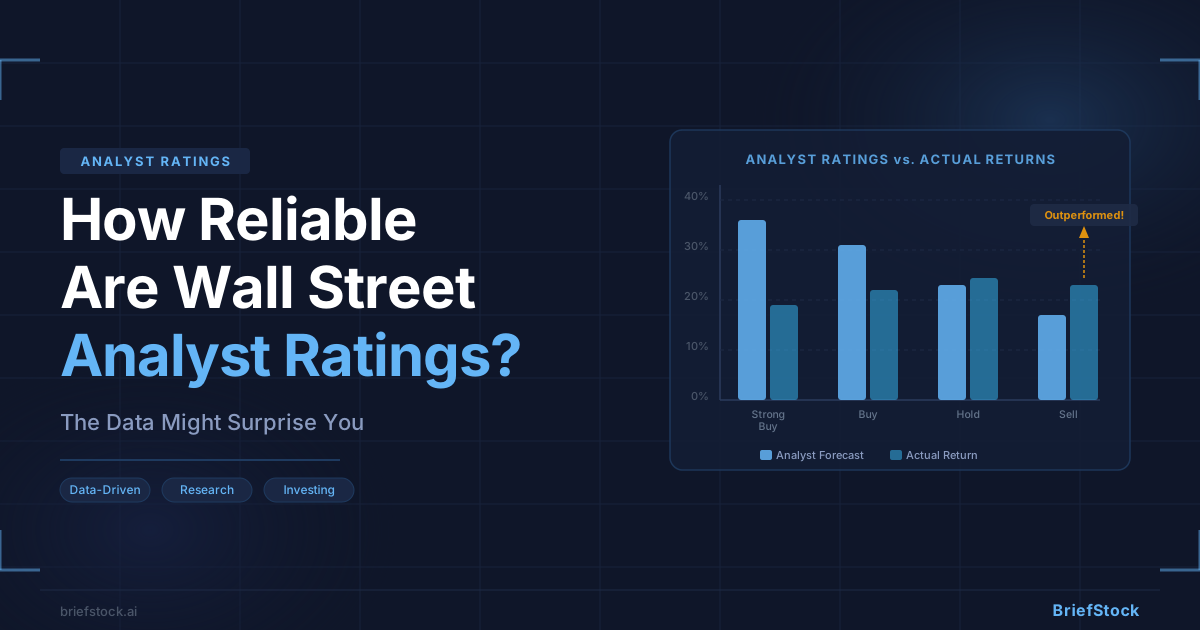
If you've ever wondered how reliable are analyst stock ratings before making a portfolio decision, you're asking exactly the right question. Wall Street employs thousands of analysts, and their buy, hold, and sell calls move markets. But the uncomfortable truth is that their track record is a lot messier than the confident tone of their research notes would suggest. Understanding where analyst ratings add value — and where they mislead — is one of the more useful skills a self-directed investor can develop.
The Uncomfortable Track Record
Academic research on analyst accuracy is not flattering. Studies consistently show that analyst buy recommendations underperform the broader market over one- and three-year horizons more often than they outperform. A frequently cited paper from the Journal of Finance found that the least-recommended stocks — the ones analysts were most cautious on — actually generated higher subsequent returns than the most-recommended ones.
Part of this is structural. Analysts are human, and they anchor heavily to recent price performance and management guidance. When a stock has run up 40% in the past year, consensus tends to upgrade toward buy. When it's fallen 30%, downgrades pile on. This is momentum-chasing dressed in the language of fundamental analysis.
It's also worth noting that "sell" ratings are genuinely rare on Wall Street. Across major brokerages, sell or equivalent ratings typically represent fewer than 5% of all active recommendations. That alone tells you something about the incentives shaping these outputs.
Conflicts of Interest Are Built Into the System
Sell-side analysts work for firms that do business with the companies they cover. Investment banking relationships, underwriting fees, and corporate access all create pressure — sometimes subtle, sometimes not — to avoid the kinds of sharp negative calls that would damage those relationships.
This doesn't mean analysts are dishonest. Most are skilled professionals working within a system that constrains them. But it does mean their ratings carry embedded conflicts that aren't always visible in the final recommendation. A "neutral" or "hold" rating can, in many cases, be a polite way of saying something the analyst can't say directly.
Regulatory changes after the dot-com bubble — particularly the Sarbanes-Oxley Act and the Global Analyst Research Settlements of 2003 — improved independence somewhat. But the structural pressures haven't gone away. The incentive to maintain access and relationships still shapes the distribution of ratings in ways that favor optimism.
Why Consensus Matters More Than Any Single Analyst
Given all of this, should you ignore analyst ratings entirely? That would be overcorrecting. When you aggregate across many analysts covering a stock, the signal-to-noise ratio improves meaningfully. Any single analyst's view can be idiosyncratic, conflicted, or simply wrong. But when a large majority of independent analysts converge on the same conclusion, that convergence tends to carry more informational weight.
The key word is "large majority." A 55% buy consensus — where just over half of covering analysts rate a stock a buy — doesn't tell you much. That could reflect genuine disagreement, a stock in transition, or simply analysts hedging. It's not a clean signal in either direction.
BriefStock treats analyst consensus as a meaningful input only when it crosses 75% buy ratings or higher. Below that threshold, the consensus is treated as noise rather than signal. This isn't arbitrary — it reflects the practical reality that weak majorities in analyst ratings have poor predictive power, while strong supermajority agreement represents something more durable.
How Reliable Are Analyst Stock Ratings at Different Thresholds?
The honest answer is: it depends heavily on the threshold you apply. At 75%+ buy consensus, you're filtering out the middle-of-the-road stocks where analysts are essentially shrugging. You're left with companies where the overwhelming weight of professional opinion points one direction — which doesn't guarantee correctness, but does represent a more defensible signal.
Consider two very different examples from the market today. META carries a P/E of 25.54 with a PEG of just 0.03, revenue growing at 16.9% year-over-year, a gross margin of 81.8%, and a Health Score of 9 out of 10. It sits in BULLISH territory across fundamental metrics. A high analyst buy consensus on META would be consistent with the underlying data — the ratings and the fundamentals are telling the same story.
TSLA, by contrast, shows revenue declining 11.4% year-over-year, a P/E of 298.82, a gross margin of just 20.1%, and a Health Score of 6 out of 10 — a CAUTIOUS verdict. If analyst consensus were broadly bullish on TSLA despite those numbers, that would be a case where consensus and fundamentals are diverging. That divergence is worth interrogating rather than accepting the rating at face value.
Conviction Threshold vs. Simple Majority
The distinction between a simple majority and a conviction threshold is conceptually simple but practically important. Think of it this way: if you were hiring someone for a critical role and 55% of your interviewers gave a thumbs up while 45% had concerns, you'd probably keep looking. But if 80% of interviewers independently converged on a strong positive, you'd treat that as a genuine signal.
Analyst ratings work the same way. The 75% threshold isn't about demanding perfection — it's about filtering for genuine conviction rather than mild preference. Stocks that clear that bar have a qualitatively different consensus profile than those sitting at 51% or 60%.
This is also where the difference between institutional and retail use of ratings becomes stark. Institutional investors and quantitative funds often weight analyst ratings using more sophisticated approaches — adjusting for analyst track records, recency, and changes in direction rather than just the static level. Retail investors rarely have access to those tools, which makes applying a simple but robust threshold even more important.
What Analyst Ratings Should and Shouldn't Tell You
Analyst ratings are most useful as one layer of a multi-factor assessment. They reflect, in aggregate, the informed view of professionals who model the business deeply, have access to management, and track industry dynamics closely. That's valuable context.
They're least useful when treated as standalone buy/sell signals, when the consensus is weak, or when the ratings conflict with underlying fundamentals. A high buy consensus on a company with deteriorating margins and declining revenue is not a comforting signal — it might just mean analysts haven't caught up to the data yet.
BriefStock's approach is to surface analyst consensus as one explicit data point alongside fundamental metrics — Health Scores, revenue growth, valuation ratios — so users can see whether ratings and fundamentals are reinforcing each other or telling different stories. Stock research that shows its work means making that relationship visible rather than presenting a verdict without context.
Building a More Skeptical, More Useful Framework
The practical takeaway isn't that analyst ratings are worthless. It's that they require calibration. A supermajority buy consensus on a stock with strong fundamentals is meaningful. A slim majority on a deteriorating business is not. And the conflicts of interest embedded in the system mean you should always ask what the incentives are behind any individual rating.
When evaluating any position, consider analyst consensus alongside growth trajectory, valuation, financial health, and margin profile. None of these variables should dominate in isolation. The power is in the convergence — when multiple independent signals point the same direction, confidence is more justified.
How reliable are analyst stock ratings ultimately comes down to how you use them. Applied uncritically, they can mislead. Applied as one signal among many, filtered for genuine conviction, they contribute meaningfully to a research process. The goal isn't to dismiss Wall Street's work — it's to use it smarter than most retail investors currently do.
Not financial advice. BriefStock is a research tool — always do your own due diligence.