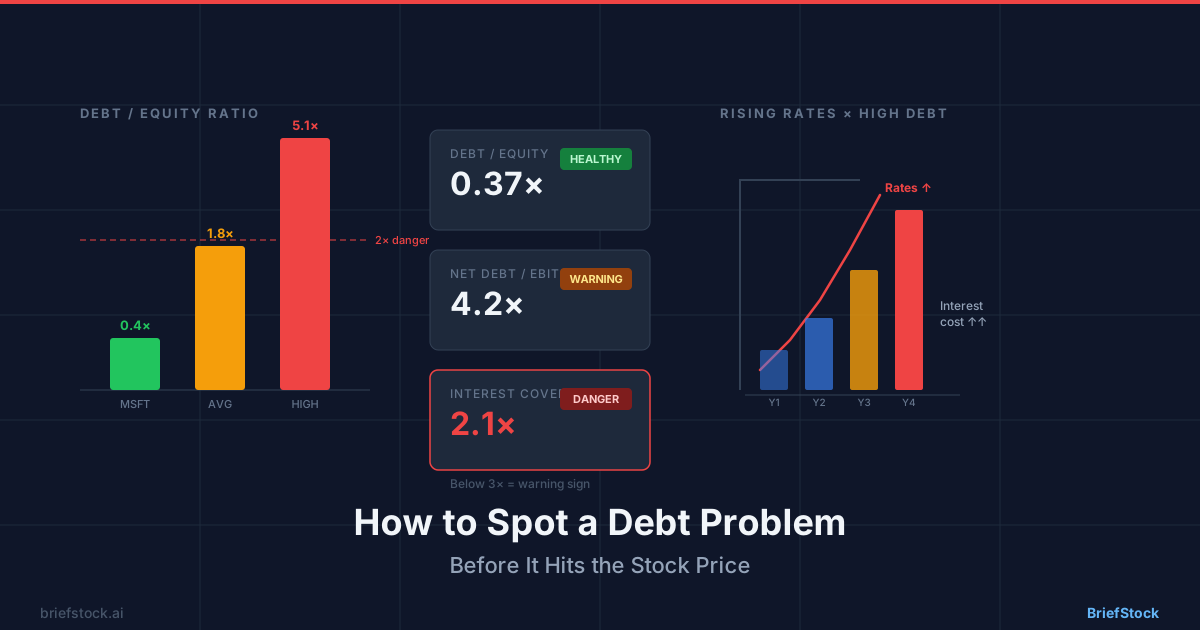
Debt is the silent killer of stock returns. A company can post strong revenue growth, expand margins, and beat earnings — all while its balance sheet quietly deteriorates. When the debt problem finally surfaces, the stock price often drops faster than fundamentals can explain. That’s why learning how to spot a debt problem in stocks is a non-negotiable skill for any serious investor. This post walks you through the three essential metrics, the danger thresholds that matter, and how to distinguish a well-leveraged company from a ticking time bomb — using real data from two of the most widely held stocks.
How to Spot a Debt Problem in Stocks – The Three Metrics That Matter
Debt analysis isn't about avoiding leverage entirely. Many great companies use debt productively to fund growth, acquisitions, or share buybacks. The problem arises when debt levels exceed the company’s ability to service them. Three ratios cut through the noise: debt-to-equity (D/E), net debt-to-EBITDA, and the interest coverage ratio.
- Debt-to-Equity measures total liabilities against shareholder equity. A D/E of 1.0 means debt equals equity. Above 2.0 warrants serious scrutiny.
- Net Debt-to-EBITDA shows how many years of cash earnings it would take to pay off net debt. A ratio above 4.0 is generally considered risky, though it varies by industry.
- Interest Coverage Ratio (EBIT / interest expense) tells you how many times operating profit can cover interest payments. Below 3.0 is a red flag; below 1.5 means the company is struggling to pay its lenders.
These three metrics form the foundation for answering “does this company have a debt problem?” Let’s see how they apply in practice.
Danger Thresholds You Need to Know
You can’t evaluate debt in a vacuum. Industry norms matter — utilities often carry higher debt loads because of predictable cash flows, while tech companies typically run lean. But there are universal warning signs.
- D/E above 2.0 – Unless the company operates in a capital-intensive sector with stable revenue (e.g., regulated utilities), a D/E over 2.0 signals elevated financial risk. Every additional dollar of debt increases fixed interest costs, reducing flexibility.
- Interest coverage below 3.0 – This is the line where operating profit can only cover interest three times or less. A downturn in earnings could quickly lead to missed payments. Below 2.0, you’re in distress territory.
- Net debt-to-EBITDA above 4.0 – For most non-financial companies, a ratio above 4.0 means it would take more than four years of EBITDA to repay net debt. That’s a long time to be at the mercy of lenders.
These thresholds aren’t absolute rules — they’re starting points. Combined, they create a quick triage system for how to spot a debt problem in stocks before the market does.
Why Rising Rates Change the Game
A company that looked fine with a D/E of 2.5 and interest coverage of 3.0 in 2021 might be in serious trouble today. That’s because the debt load doesn’t change — but the cost of servicing it does. When interest rates rise, floating-rate debt becomes more expensive, and refinancing fixed-rate debt at higher rates squeezes margins.
Consider a company with $10 billion in debt that pays an average interest rate of 3%. Annual interest expense is $300 million. If rates rise to 6%, that expense doubles to $600 million — assuming the debt rolls over. For a company with EBIT of $1 billion, interest coverage drops from 3.3x to 1.7x in one refinancing cycle.
This is why debt problems often emerge during rate hiking cycles. The balance sheet hasn’t changed, but the income statement feels the pain. Investors watching solely earnings miss the real story. The interest coverage ratio is the canary in the coal mine.
Contrasting Two Balance Sheets: META vs. MSFT
Let’s apply these metrics to real-world examples. Both Meta Platforms (META) and Microsoft (MSFT) are tech giants with pristine health scores of 9/10 from BriefStock. But their debt profiles reveal why leverage alone doesn’t tell the full story.
- META has a Debt/Equity of 0.39 — very low. Its P/E is 21.26, PEG 0.35, revenue growth 33.1%, FCF yield 3.0%, and gross margin 81.9%. The verdict is BULLISH. Meta operates with minimal debt, spending heavily on AI infrastructure from cash flow rather than borrowing. Its interest coverage is off the charts (no significant interest expense).
- MSFT has a Debt/Equity of 0.33 — even lower. P/E 24.3, PEG 1.05, revenue growth 18.3%, FCF yield 2.3%, gross margin 67.6%. Also BULLISH. Microsoft does carry some long-term debt, but its cash and short-term investments easily cover it. Net debt is actually negative (more cash than debt).
Both companies are well-capitalized. Neither shows any sign of a debt problem. But compare them to a hypothetical firm with D/E of 2.5, interest coverage of 2.8, and negative FCF — that company would flash red on every debt metric, regardless of revenue growth. The presence of high growth can mask a debt problem, but it doesn’t cure it.
How to Find These Metrics Quickly
You don’t need to dig through 10-K filings to find these numbers. Most quality research platforms surface them automatically. In BriefStock, for example, the Debt/Balance Sheet signal dimension is one of the five core pillars of the health score. You can see D/E, net debt-to-EBITDA, and the interest coverage ratio at a glance, along with trend lines showing whether debt is increasing or decreasing over the last few quarters.
When scanning a new stock, I look at three things in under 30 seconds:
- Debt/Equity – Is it below 1.0? If above 2.0, flag it.
- Interest Coverage – Is it above 5.0? Below 3.0? Trend up or down?
- Free Cash Flow – Is the company generating enough cash to pay down debt if needed?
If a stock scores poorly on debt metrics but has a high overall health score, I dig deeper. Sometimes a one-time acquisition spikes debt temporarily. That’s different from chronic over-leverage.
The Role of Debt in the Health Score
BriefStock’s health score aggregates five dimensions: Profitability, Growth, Valuation, Momentum, and Debt/Balance Sheet. Each dimension contributes equally to the final score (1–10). A strong debt profile can lift an otherwise average stock, while a weak one can drag down a company with great margins and growth.
For instance, a company with 8/10 profitability and 7/10 growth might still earn only a 6/10 overall if its debt dimension scores 3/10. The health score forces you to confront the balance sheet risk, even when the income statement looks attractive.
When you see a stock with a BULLISH verdict and a health score of 9/10 — like META or MSFT — you can be confident that debt is not a hidden problem. The data is transparent, and the work has been shown. That’s the value of structured research: you don’t have to guess.
Conclusion
The market often prices in debt problems only when they become visible — after earnings miss, after a dividend cut, after a credit rating downgrade. By then, the stock has already fallen. Learning how to spot a debt problem in stocks gives you a leading indicator. Track debt-to-equity (above 2x is a yellow flag), interest coverage (below 3x is a red flag), and net debt-to-EBITDA (above 4x is trouble). Combine these with an understanding of how rising interest rates compound risk, and you’ll avoid the worst blowups. Tools like BriefStock surface these metrics instantly, so you spend your time interpreting data instead of hunting for it. Always verify the balance sheet before you trust the income statement.
Not financial advice. BriefStock is a research tool — always do your own due diligence.